
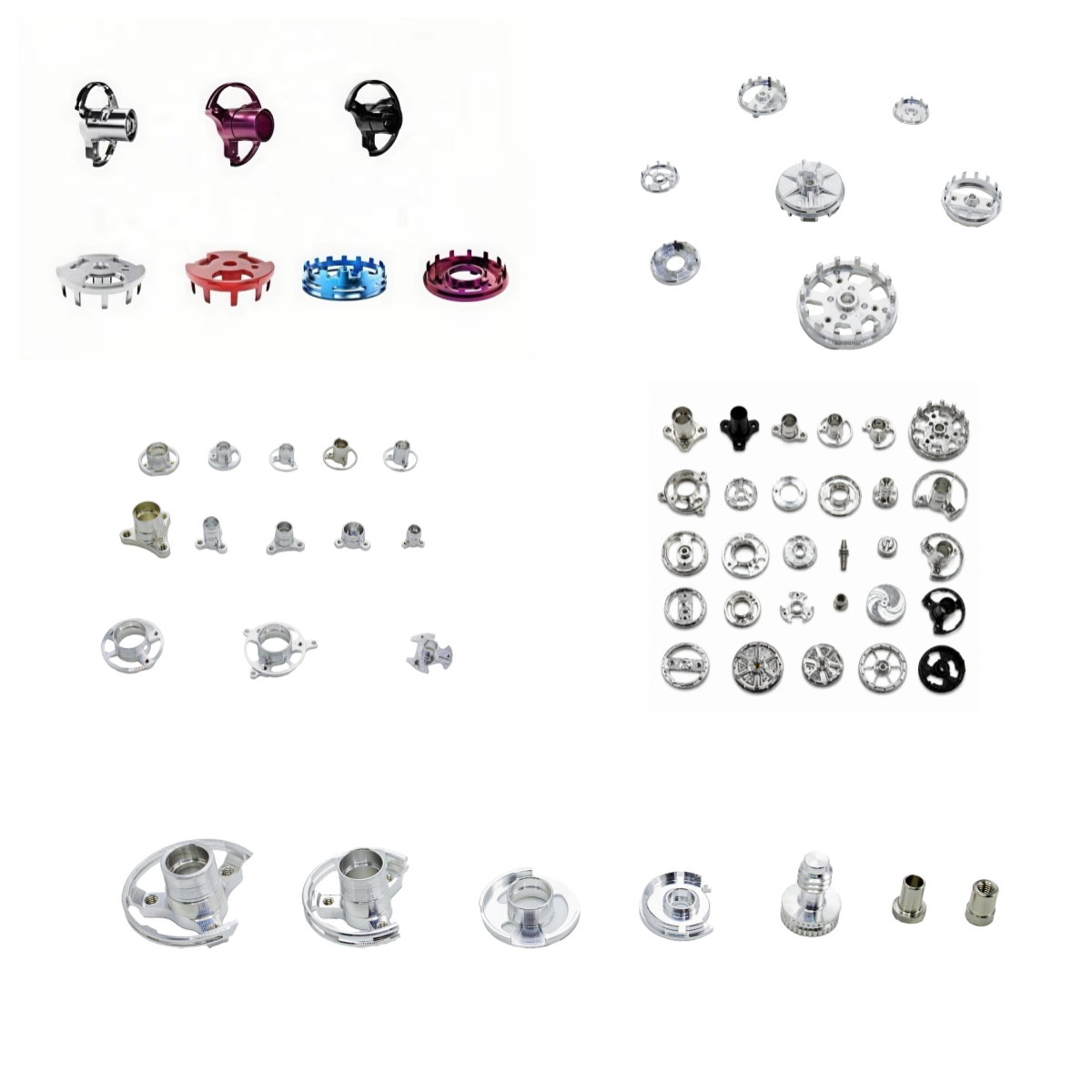
Brushless motors are the heart of a drone’s propulsion system. Whether used in FPV racing drones, aerial photography drones, agricultural UAVs, industrial inspection platforms, mapping systems, or other unmanned aircraft, the motor must provide stable rotation, sufficient torque, efficient power transmission, and reliable operation.
However, motor performance does not depend only on the winding, magnets, stator, or electronic controller. The mechanical components inside the motor are equally important.
A rotor bell with poor concentricity can create unwanted vibration. An incorrectly machined motor shaft can affect bearing fit and propeller alignment. An inaccurate magnetic ring support can influence the position of permanent magnets. A motor cover with an improperly machined bearing seat can affect the overall alignment of the rotating assembly.
For this reason, precision CNC machining plays an important role in the manufacturing of modern UAV motor components.
We provide customized CNC machined drone motor parts for UAV manufacturers, brushless motor manufacturers, drone brands, engineering companies, and OEM customers. Our product range includes rotor bells, rotor cups, magnetic ring components, motor shafts, motor covers, bearing seats, sleeves, spacers, retaining rings, and other precision metal motor components.
With Japanese STAR, Citizen, and Tsugami CNC equipment, multi-axis machining capabilities, professional inspection equipment, and a machining tolerance capability of up to ±0.005 mm for suitable components, we support precision manufacturing from prototype to mass production.
A drone motor is a compact electromechanical assembly in which multiple components must work together accurately.
Depending on the motor design, mechanical components may include:
Although some of these components appear simple, their dimensional relationships can have a significant influence on the performance of the finished motor.
The rotor bell is a core component of many brushless drone motors.
It forms the rotating outer structure of the motor and provides the mechanical structure for the permanent magnets.
Because the rotor bell rotates at high speed, several dimensions require careful control.
These may include:
The rotor bell also needs to balance lightweight construction with sufficient structural strength.
For drone applications, aluminum alloy is often a suitable material because of its low density and good machinability.
The term rotor cup is also commonly used for specific brushless motor rotor structures.
Depending on the customer’s motor design, a rotor cup may have:
Precision CNC turning can produce these features accurately while maintaining repeatability between production batches.
For OEM drone motor manufacturers, the rotor cup can be manufactured according to a customer’s 2D drawing or 3D CAD model.
The magnetic ring is closely related to the rotor assembly.
Permanent magnets are positioned around the rotor and interact with the stator’s magnetic field during motor operation.
The mechanical components associated with the magnetic ring can include:
These parts provide a mechanical reference for magnet installation.
Consistent dimensions can help maintain a uniform magnetic arrangement and reduce potential assembly variation.
Permanent magnets inside a drone motor must remain securely positioned during high-speed operation.
Depending on the motor design, retaining structures can include:
These features can be machined according to the customer’s specific motor structure.
The exact material and surface treatment can also be selected according to the operating environment.
The motor shaft is responsible for transmitting rotational motion to the propeller or other rotating components.
It is also closely connected with the motor bearings.
A precision motor shaft may include:
The shaft geometry depends on the motor architecture and customer requirements.
For high-speed drone motors, dimensional accuracy and concentricity are particularly important.
Stainless steel is commonly considered for precision motor shafts because it offers a combination of strength, corrosion resistance, and dimensional stability.
Common options include:
Carbon steel and alloy steel can also be used where higher mechanical strength or specific mechanical properties are required.
Material selection can be based on:
Bearings support the rotating shaft and rotor assembly.
The bearing seat therefore requires accurate dimensional control.
Typical requirements may include:
An incorrect bearing seat can affect the fit between the bearing and housing.
Potential consequences include:
For this reason, bearing-related components are inspected carefully during CNC production.
Bearing sleeves can be used to support or position bearings within a motor assembly.
These components are often small cylindrical parts with tight dimensional requirements.
Our Swiss-type CNC machining capabilities are suitable for producing:
These components can be manufactured in stainless steel, brass, aluminum, carbon steel, or other specified materials.
The motor cover or end cover provides structural support and protects internal components.
Depending on the design, it may contain:
The cover can be manufactured from aluminum, stainless steel, or other engineering materials according to the motor design.
For lightweight drone motors, aluminum alloy is often selected to reduce unnecessary weight.
Weight is an important consideration in UAV design.
Reducing the weight of individual motor components can contribute to the overall weight optimization of the aircraft.
Aluminum 6061-T6 and 7075-T6 are commonly used engineering alloys that offer a useful balance between weight and mechanical performance.
Possible applications include:
Spacers are small but important components used to maintain controlled distances between motor components.
Applications may include:
A spacer may be a simple cylindrical ring, but its thickness and parallelism can affect the overall assembly.
We manufacture custom motor spacers according to customer drawings.
Shaft collars and retaining rings can be used to control the axial position of components.
These components may require:
They can be manufactured according to specific motor assembly requirements.
Choosing the correct material is important for achieving the required combination of weight, strength, corrosion resistance, and machinability.
6061-T6 is widely used for CNC machined UAV components.
Key advantages include:
It can be used for:
7075-T6 offers higher strength and is suitable for more demanding applications.
It can be considered for:
Stainless steel provides good corrosion resistance and mechanical strength.
Common grades include:
Typical applications include motor shafts, sleeves, pins, and precision hardware.
Brass is an excellent machining material for small precision components.
It may be used for:
Steel materials can be selected for components requiring higher mechanical strength.
Surface treatment can be applied according to the customer’s requirements.
Surface treatment can improve corrosion resistance, wear resistance, surface hardness, and appearance.
Anodizing is commonly applied to aluminum motor components.
It can provide:
Black anodizing is widely used for drone motor components.
It provides a clean technical appearance and is suitable for:
Hard anodizing provides a more durable aluminum surface and can be considered for components exposed to repeated mechanical contact.
Sandblasting can provide a uniform matte finish.
It is often used before anodizing to create a consistent surface appearance.
Polishing can improve surface smoothness and appearance for suitable materials.
Zinc plating can provide additional corrosion protection for suitable carbon steel components.
Nickel plating can provide corrosion resistance and improved surface durability for selected components.
Manufacturing precision UAV motor components requires controlled machining processes.
A typical production process may include:
The customer’s drawing is reviewed for:
The specified material is prepared for machining.
The component is manufactured using suitable CNC equipment.
Sharp edges and machining burrs are removed.
The required finishing process is applied.
Critical dimensions are inspected.
Appearance, quantity, dimensions, and packaging are checked before shipment.
Our factory uses advanced CNC equipment for precision metal component manufacturing.
Japanese STAR Swiss-type CNC machines are especially suitable for:
Their design provides strong support for small workpieces and is suitable for high-precision production.
Citizen CNC equipment supports automatic precision turning and repeatable production.
It is suitable for complex small-diameter components and high-volume manufacturing.
Tsugami equipment supports precision turning and complex machining requirements.
Multi-axis machining can produce components with multiple features and machining surfaces.
It is suitable for:
Our inspection capabilities include:
These tools support dimensional inspection and production quality control.
Every precision motor component needs to meet the customer’s technical requirements.
Our quality control process includes:
Materials are checked according to project specifications.
Initial samples are inspected before volume production.
Critical dimensions are monitored during production.
Completed parts are inspected before shipment.
Depending on the project, inspection can include:
Precision drone motor components often require tighter tolerances than general industrial hardware.
Our machining capability can reach ±0.005 mm for suitable components.
However, actual achievable tolerances depend on:
For this reason, we evaluate customer drawings before confirming production specifications.
Every motor manufacturer may have a different mechanical structure.
We therefore support customized OEM manufacturing.
Customers can provide:
We can manufacture a complete set of motor components according to the customer’s design.
For example:
Rotor Bell + Magnetic Ring Holder + Motor Shaft + Motor Cover + Bearing Sleeve + Spacer + Retaining Ring
This allows customers to source multiple precision motor components from one manufacturing partner.
Our CNC machined motor components can be used for various UAV platforms.
High-speed FPV motors require accurate and lightweight mechanical components.
Camera drones require reliable propulsion systems for stable flight.
Agricultural UAV motors may operate for extended periods and in outdoor environments.
Industrial UAVs may carry cameras, sensors, and other payloads.
Stable motor operation is important for accurate aerial surveying.
Heavy-lift drones require motor components capable of handling greater mechanical loads.
Delivery drones require efficient propulsion systems and reliable motor assemblies.
We specialize in precision CNC metal components and can achieve tolerances up to ±0.005 mm for suitable parts.
We manufacture rotor bells, rotor cups, magnetic ring components, shafts, covers, sleeves, spacers, bushings, and other customized motor hardware.
STAR, Citizen, and Tsugami equipment support stable production of small and complex components.
We work with aluminum, stainless steel, brass, carbon steel, alloy steel, and copper alloys.
We can arrange anodizing, hard anodizing, sandblasting, polishing, zinc plating, nickel plating, and other finishing processes.
CMM, optical measurement, CCD inspection, microscopes, and precision gauges support our quality control system.
We manufacture according to customer drawings, samples, CAD files, and technical specifications.
We support prototype development, small-batch production, and high-volume manufacturing.
Our ISO 9001 quality management system supports standardized production, inspection, documentation, and continuous improvement.
IATF 16949 is an internationally recognized quality management standard for the automotive industry and supply chain.
Our quality management systems support controlled production processes and consistent product quality.
The mechanical structure of a brushless drone motor directly influences the stability and reliability of the propulsion system.
Components such as the rotor bell, rotor cup, magnetic ring, motor shaft, motor cover, bearing sleeve, spacer, and retaining ring may be small, but each one plays an important role in the final motor assembly.
Precision CNC machining allows these components to be manufactured with controlled dimensions, consistent interfaces, and repeatable quality.
With Japanese STAR, Citizen, and Tsugami CNC equipment, multi-axis machining capabilities, professional inspection equipment, multiple material options, and a machining tolerance capability of up to ±0.005 mm, we provide customized CNC drone motor components for UAV manufacturers worldwide.
Whether you need a small batch of prototype motor shafts or a complete production program covering rotor bells, magnetic ring holders, motor covers, sleeves, and spacers, we can support your project from engineering review to mass production.
Our goal is to provide reliable precision metal components that help UAV manufacturers build efficient, stable, lightweight, and durable brushless drone motors.
If you are interested in this exceptional product, please feel free to contact us through the message box on the left side or the contact information provided below. We are eager to collaborate with you for a brighter future!