
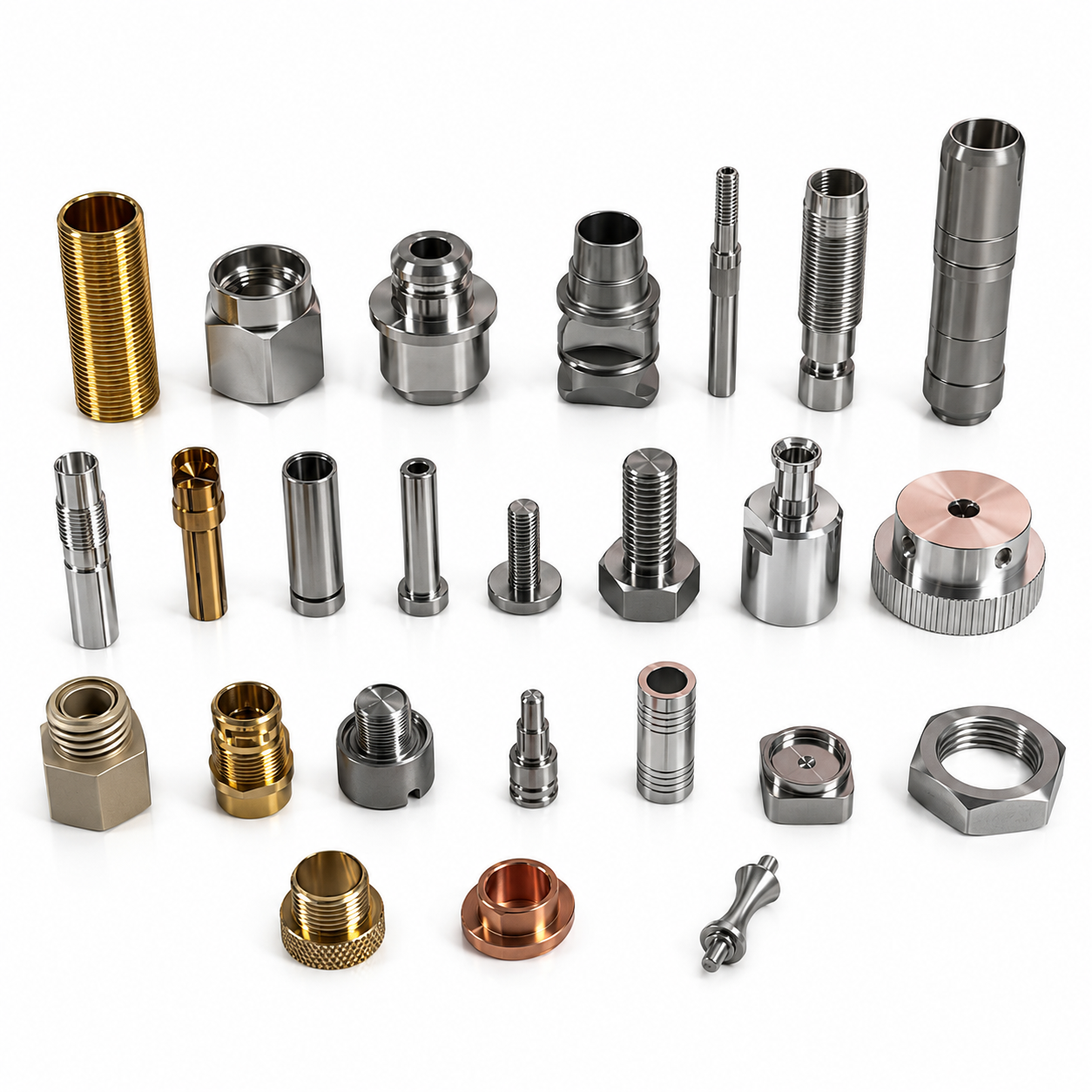
Modern electronic equipment is becoming smaller, faster, and more integrated. Behind every connector, sensor, communication device, control system, and electronic module are precision metal components that determine how reliably the complete system operates.
While electronic products may appear to be dominated by chips, PCBs, and wiring, many critical functions still depend on accurately machined metal components. Connector housings need precise dimensions. Contact pins require consistent geometry. Sensor sleeves must maintain stable positioning. Bushings and spacers must control assembly clearances. Shafts and miniature mechanical components need smooth surfaces and accurate concentricity.
For these applications, precision CNC electronic components provide an important combination of dimensional accuracy, material flexibility, surface quality, and repeatable production.
As a professional precision CNC machining manufacturer, we provide customized electronic precision components for connectors, sensors, communication equipment, industrial automation systems, automotive electronics, testing equipment, robotics, and other demanding applications.
Our CNC machining capabilities support complex miniature components in stainless steel, aluminum, brass, copper alloys, carbon steel, titanium, and engineering plastics. For suitable components and production conditions, machining tolerances can reach ±0.005 mm, helping customers maintain consistent assembly and functional performance.
Electronic precision components are small mechanical or metal parts used inside electronic and electromechanical systems. Unlike standard electronic components such as resistors, capacitors, and integrated circuits, these parts usually provide mechanical, structural, conductive, positioning, fastening, or protective functions.
Typical CNC electronic precision components include:
These components may be only a few millimeters in size, but their dimensional requirements can be extremely demanding.
A difference of several hundredths of a millimeter can affect insertion force, electrical contact, alignment, sealing, rotation, or assembly stability.
This is why electronic equipment manufacturers often work with precision CNC machining suppliers rather than relying entirely on conventional machining methods.
Connectors are one of the most common applications for precision-machined electronic metal parts.
A connector may need to be repeatedly inserted and removed thousands of times while maintaining reliable mechanical and electrical performance. Its internal components therefore require consistent dimensions and controlled surface quality.
CNC machining can be used to manufacture many connector-related components, including:
Connector housings provide structural support and alignment for internal components.
Depending on the application, they can be manufactured from aluminum, brass, stainless steel, copper alloys, or other engineering materials.
Important manufacturing requirements may include:
For miniature cylindrical connector components, Swiss-type CNC turning is particularly suitable because the machine can maintain stable positioning while machining small-diameter workpieces.
Contact pins are another important category of precision electronic components.
These parts may combine very small diameters with tight dimensional tolerances. Their surfaces must also be clean and smooth because surface quality can influence electrical contact and assembly behavior.
Common materials include:
Depending on customer requirements, contact components can receive polishing or plating processes to achieve the desired conductivity, corrosion resistance, appearance, and wear resistance.
Sensors are used in industrial automation, automotive systems, robotics, medical equipment, aerospace equipment, consumer electronics, and many other fields.
Although the electronic sensing element is critical, the mechanical components around it are equally important.
CNC machining can manufacture:
A sensor housing protects sensitive internal components while providing the required mechanical interface with the surrounding equipment.
Depending on the design, a sensor housing may require:
These geometries can be produced through CNC turning, milling, drilling, threading, grooving, and other precision machining operations.
Sensor positioning is extremely important in many applications.
A sensor that is mechanically misaligned may produce inaccurate measurements even if the electronic sensing element itself is functioning correctly.
Precision-machined mounting components can help control:
This makes precision CNC components particularly valuable for industrial sensors and automated inspection systems.
Communication equipment often requires compact and lightweight components with excellent dimensional consistency.
Examples include:
For communication applications, materials are often selected based on conductivity, corrosion resistance, weight, mechanical strength, and thermal properties.
Brass and copper alloys are frequently considered where electrical conductivity is important, while aluminum is attractive when low weight and heat dissipation are priorities.
Stainless steel can be selected where strength and corrosion resistance are more important.
Not every electronic precision component is directly involved in electrical conduction.
Many components perform mechanical positioning functions.
Bushings, sleeves, and spacers are widely used in electronic and electromechanical assemblies.
Bushings can be used to:
A bushing normally requires accurate internal and external diameters.
The relationship between these dimensions is particularly important because a bushing may need to fit precisely into a housing while also providing the correct clearance for another component.
CNC-machined sleeves are used in:
Sleeves may be simple cylindrical components or include multiple diameters, grooves, shoulders, holes, and threads.
Spacers control the distance between components.
They may look simple, but their length tolerance can have a major influence on final assembly.
In electronic equipment, spacers can help establish:
For this reason, precision spacer manufacturing is often more demanding than it initially appears.
Miniature shafts are another important type of electronic precision component.
They can be used in:
A precision shaft may require several different diameters along its length.
Typical features include:
The key manufacturing requirements often include diameter tolerance, concentricity, straightness, surface finish, and accurate positioning of each feature.
Swiss-type CNC machining is well suited to long, small-diameter shafts because the workpiece can be supported close to the cutting area during machining.
Material selection is one of the most important stages in CNC electronic component manufacturing.
Different applications require different combinations of strength, conductivity, corrosion resistance, weight, machinability, thermal performance, and surface characteristics.
We support a wide range of materials for customized precision components.
Stainless steel is widely used for electronic precision components that require:
Common stainless-steel options include SUS303, SUS304, and SUS316.
SUS303 is often selected when machinability is important.
SUS304 provides a balanced combination of corrosion resistance and mechanical performance.
SUS316 is commonly considered when higher corrosion resistance is required.
Applications include:
Aluminum is popular for lightweight electronic components.
Common grades include 6061-T6 and 7075-T6.
Aluminum provides:
It is commonly used for:
Black anodizing can also provide aluminum parts with a more durable and professional surface.
Brass is frequently used for precision electronic components because of its machinability and electrical conductivity.
Typical applications include:
Brass can also provide a distinctive metallic appearance and is suitable for many small turned components.
Copper-based materials are useful where electrical and thermal conductivity are important.
Potential applications include:
Because copper can behave differently from stainless steel or brass during machining, cutting conditions and tool selection need to be adjusted accordingly.
Carbon steel can be used for components where strength and cost efficiency are important.
Typical applications include:
Surface treatment may be applied to improve corrosion resistance or wear performance.
Titanium is attractive for applications requiring:
It is often considered for demanding aerospace, industrial, and specialized electronic applications.
Certain electronic assemblies may require non-metallic precision components.
Engineering plastics can be considered for:
Material selection should always be based on the actual operating environment, temperature, load, chemical exposure, and electrical requirements.
Machining creates the basic geometry of a component, but surface treatment can further improve its performance and appearance.
Depending on the material and application, available finishing options may include:
Anodizing is widely used for aluminum components.
It can improve:
Black anodizing is particularly popular for industrial electronic equipment because it provides a clean and professional appearance.
Hard anodizing provides a harder and more wear-resistant aluminum surface.
It can be useful for components exposed to repeated mechanical contact.
Sandblasting can create a uniform matte surface.
It is often combined with anodizing for aluminum components.
Polishing improves surface smoothness and visual appearance.
It may be appropriate for:
Nickel plating can improve surface durability and corrosion resistance while providing a controlled metallic appearance.
It can also be used on certain electronic components where surface properties are important.
Zinc plating is commonly used for steel components requiring improved corrosion resistance.
Passivation is commonly applied to stainless-steel components to enhance corrosion resistance and maintain a clean surface.
A reliable CNC manufacturing process starts long before the machine begins cutting material.
A professional production workflow typically includes several important stages.
Customer drawings are reviewed for:
If a dimension or manufacturing requirement is unclear, clarification should be completed before production begins.
The correct raw material is selected according to the drawing.
Material specifications and dimensions are checked before machining.
For production orders, material consistency is important because differences in material properties can influence machining behavior and final dimensions.
Depending on the component geometry, manufacturing may involve:
The machining process is selected according to the size, geometry, tolerance, and production quantity.
After machining, sharp edges and burrs need to be removed.
This is especially important for miniature electronic components because small burrs can interfere with assembly.
Deburring can help improve:
If required, components are sent for anodizing, plating, polishing, passivation, sandblasting, or another specified finishing process.
Finished components are inspected according to the drawing and quality requirements.
Inspection may include:
Before shipment, parts are checked for:
This helps ensure that the delivered components match the customer’s specifications.
The production equipment has a direct influence on the accuracy and repeatability of small electronic components.
Our CNC machining capabilities include automatic precision turning equipment and multi-axis machining equipment suitable for small and complex metal components.
Our equipment includes precision CNC machines from manufacturers such as:
Swiss-type CNC lathes are particularly suitable for miniature cylindrical components because they provide stable workpiece support during machining.
This is valuable for parts such as:
For complex components, multi-axis machining can reduce the number of setups required and improve positional consistency between multiple features.
CNC machining accuracy alone is not enough.
A precision component manufacturer also needs a reliable inspection system.
Our inspection capabilities include equipment such as:
For high-precision electronic components, inspection can be performed on critical dimensions according to customer drawings.
For suitable products, dimensional tolerances can reach ±0.005 mm.
However, tolerance should always be evaluated according to the actual component structure, material, dimension, machining process, and functional requirement rather than applying an unnecessarily tight tolerance to every feature.
A tolerance defines how much a manufactured dimension can vary from the nominal value.
For electronic precision components, tolerance may influence:
Consider a precision sleeve.
If the internal diameter is too small, assembly may become difficult.
If it is too large, excessive clearance may cause unwanted movement.
The same principle applies to shafts, bushings, connector bodies, and sensor housings.
Therefore, the most important question is not simply:
“How tight can the tolerance be?”
Instead, it is:
“Which dimensions actually require tight tolerances for the function of the component?”
This engineering approach can help manufacturers achieve reliable performance while maintaining reasonable production costs.
Every electronic product is different.
Standard catalog components may not always fit a customer’s housing, connector, sensor, PCB, motor, or mechanical structure.
Custom CNC manufacturing allows the component geometry to be developed directly from the customer’s requirements.
We support OEM and ODM projects involving:
A custom CNC project may start with only a drawing or sample.
The manufacturing team can then evaluate:
This approach makes CNC machining suitable for both new product development and established production programs.
Electronic products often go through multiple development stages.
A project may begin with only a few prototype components.
After testing and validation, production quantities can increase significantly.
A suitable CNC supplier should therefore be able to support different stages of the project.
Prototype machining allows engineers to verify:
Small-batch production is useful for:
Once the design is finalized, production focuses heavily on:
The same component must maintain consistent dimensions across different production batches.
Industrial automation systems contain a large number of mechanical and electronic components.
These systems may include:
Precision CNC components can be used throughout these systems.
Typical products include:
Because automated equipment often operates continuously, component consistency is extremely important.
Robotic systems combine electronics and mechanical motion.
Small precision parts can therefore have a major impact on robotic performance.
CNC-machined components may be used in:
Shafts, bushings, sleeves, spacers, and mounting components must often maintain accurate alignment during repeated motion.
Material selection may also depend on weight requirements.
For example, aluminum can help reduce moving mass, while stainless steel may be preferred where strength or wear resistance is more important.
Modern vehicles contain increasingly sophisticated electronic systems.
Examples include:
Precision CNC components can support these systems through mechanical interfaces, housings, mounting structures, shafts, sleeves, and connector-related components.
Automotive applications can be demanding because components may experience:
This makes material selection, machining accuracy, surface treatment, and quality control particularly important.
Testing and measurement equipment often requires high dimensional precision.
These systems may include:
Precision-machined metal parts can be used for:
Because measurement equipment is designed to detect very small differences, mechanical stability and dimensional repeatability are essential.
Miniaturization is one of the biggest trends in modern electronics.
As products become smaller, mechanical components must become smaller as well.
This creates several manufacturing challenges.
Miniature shafts and pins require stable machining conditions.
A small component may contain multiple diameters, grooves, threads, holes, and shoulders.
Smaller assemblies may have less room to compensate for dimensional variation.
A burr that appears insignificant on a large component can become a major problem on a miniature component.
Small contact surfaces can require controlled roughness and clean finishing.
These challenges make precision CNC machining particularly valuable for miniature electronic hardware.
Choosing a supplier involves more than comparing unit prices.
Several factors should be considered.
Check whether the manufacturer has suitable equipment for your component dimensions and geometry.
Confirm that the supplier can work with the required materials and understands their machining characteristics.
The manufacturer should be able to identify critical dimensions and consistently control them.
Ask what inspection equipment is available and how critical dimensions are verified.
If your component requires anodizing, plating, polishing, passivation, or another treatment, confirm that the supplier can manage the complete process.
For larger orders, production capacity and process stability become important.
A structured quality-management system can provide additional confidence in production control.
Quality management is an important part of precision manufacturing.
Our quality system includes:
ISO 9001
ISO 9001 provides a framework for quality management and process control.
IATF 16949
IATF 16949 is an automotive-focused quality management standard and is particularly relevant to suppliers serving automotive-related applications.
For customers requiring consistent production quality, documentation, inspection records, and controlled manufacturing processes, these quality systems provide an important foundation.
Our precision CNC electronic components can be customized for many industries, including:
The same basic machining technology can be adapted to different industries by changing the material, geometry, tolerance, surface treatment, and inspection requirements.
Our product range can be customized according to customer drawings and applications.
Common product types include:
Connector Components
Sensor Components
Mechanical Precision Components
Communication Components
A successful CNC project requires communication between the customer and manufacturer.
When reviewing a new electronic precision component, several questions are useful:
Providing complete information at the beginning can help reduce unnecessary engineering changes later.
If you have a 2D drawing or 3D model, the manufacturing team can evaluate the component and recommend a suitable machining process.
Packaging is often overlooked, but it is particularly important for small precision parts.
Components may need protection from:
Depending on the product, packaging may include:
For small components with cosmetic or dimensional requirements, separating the parts during transportation can help reduce contact damage.
Electronic precision components are often installed into compact assemblies.
Burrs, chips, or machining debris can interfere with assembly.
For example, a small burr inside a threaded hole may affect thread engagement.
A burr around a connector opening may interfere with insertion.
Machining debris inside a sensor housing may affect internal components.
Therefore, deburring and cleaning are important parts of the production process.
A precision component should not only meet the drawing dimensions but also arrive in a condition suitable for assembly.
Precision does not always mean maximum cost.
Good component design can help balance precision and manufacturing efficiency.
Several factors influence CNC component cost:
One effective approach is to assign tight tolerances only to dimensions that actually require them.
For example, a functional shaft diameter may require a tight tolerance, while a non-functional external dimension may be able to use a more relaxed tolerance.
This can reduce machining difficulty without compromising product performance.
We focus on customized precision metal components rather than one-size-fits-all products.
Our manufacturing advantages include:
Suitable components can be machined to tolerances down to ±0.005 mm.
Swiss-type CNC machining is suitable for miniature shafts, pins, sleeves, bushings, and other small components.
We support stainless steel, aluminum, brass, copper alloys, carbon steel, titanium, and engineering plastics.
Anodizing, black anodizing, hard anodizing, sandblasting, polishing, plating, and passivation can be selected according to material and application.
Complex components can be produced using multi-axis CNC machining where appropriate.
Precision measurement equipment is used to verify critical dimensions.
Custom components can be manufactured according to customer drawings, samples, and specifications.
We can support prototype development, small-batch production, and larger production orders.
Electronic systems are becoming smaller and more sophisticated, but the need for reliable mechanical components remains.
A connector still needs accurate alignment.
A sensor still needs stable positioning.
A shaft still needs controlled diameter and concentricity.
A bushing still needs the correct clearance.
A housing still needs consistent dimensions.
These seemingly small details can have a significant influence on the performance of the final product.
Precision CNC machining provides a flexible manufacturing solution for these applications because it can produce complex geometries, miniature components, different materials, and customized specifications from the same manufacturing platform.
From connector pins and sensor housings to communication components, miniature shafts, bushings, sleeves, spacers, and custom electronic hardware, precision CNC machining can provide the dimensional consistency required by modern electronic and electromechanical products.
If you are looking for a custom CNC electronic components manufacturer, you can provide your drawing, 3D model, sample, material requirement, or target quantity for evaluation. The right machining process, material, surface treatment, and inspection method can then be selected according to your actual application.
If you are interested in this exceptional product, please feel free to contact us through the message box on the left side or the contact information provided below. We are eager to collaborate with you for a brighter future!