
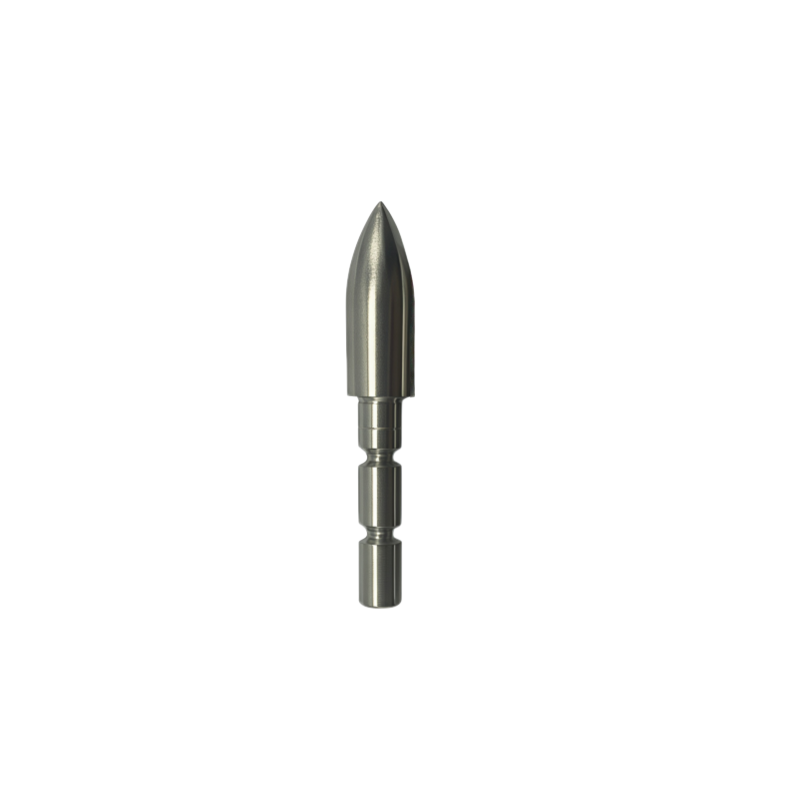
Arrow tips are small but highly engineered metal components used in the production of different types of arrows and archery equipment. For manufacturers, distributors and sporting goods brands, the quality of an arrow tip depends not only on its appearance, but also on dimensional consistency, material selection, machining quality and production repeatability.
With modern CNC machining technology, custom CNC arrow tips can be manufactured according to precise engineering drawings, samples and production specifications.
As a precision CNC machining manufacturer, we provide customized manufacturing of arrow tips, arrow points, inserts, bushings, sleeves, collars and other small metal components for OEM and ODM customers.
Our production capabilities include CNC turning, Swiss-type CNC machining and multi-axis CNC machining. Depending on the design, materials can include stainless steel, brass, aluminum, steel, copper, titanium and engineering plastics.
For suitable precision components, machining tolerances can reach ±0.005 mm, depending on the material, geometry, dimensions and required machining process.
A CNC machined arrow tip is a precision metal component produced using computer-controlled machining equipment.
Unlike simple mass-produced metal shapes, CNC machining allows manufacturers to control individual dimensions and features according to a technical drawing.
A custom arrow tip may include:
The exact geometry depends entirely on the customer’s product design.
For OEM manufacturers, CNC machining provides the flexibility to create proprietary arrow tip designs instead of relying only on standardized components.
Every sporting equipment manufacturer can have different product requirements.
One customer may require a lightweight aluminum component, while another may need a stainless steel or brass component.
A custom CNC supplier should therefore be able to adapt the machining process to the customer’s design.
We accept:
Before production, the drawing can be reviewed for manufacturability.
This review may focus on:
The goal is to establish a practical manufacturing process before production begins.
Many arrow tips have rotational geometries, making CNC turning an effective manufacturing process.
Typical CNC turning operations may include:
The raw material is cut to establish a controlled end surface.
The outside diameter and profile are machined according to the drawing.
Internal holes can be produced when required by the design.
Internal diameters can be machined to tighter specifications.
Internal or external threads can be produced according to the specified thread standard.
Precision grooves can be machined where required.
Edges can be machined to the specified chamfer dimensions.
The finished component is separated from the bar stock.
The exact sequence depends on the design and material.
For small-diameter precision parts, Swiss-type CNC machining provides an efficient manufacturing solution.
Swiss-type CNC machines are designed for machining small and slender components with excellent workpiece support.
This makes them suitable for many small precision arrow parts, including:
Our equipment includes Japanese STAR Swiss-type CNC machines.
For high-volume production, Swiss CNC machining can provide stable repeatability while reducing unnecessary manual operations.
This is particularly valuable when an OEM customer needs large quantities of small components with consistent dimensions.
Stainless steel is a common choice for precision-machined components when corrosion resistance and durability are important considerations.
Depending on the project, available stainless steel options may include:
Stainless steel CNC arrow tips can be manufactured with:
The specific grade should be selected according to the customer’s product requirements.
Stainless steel can also provide a clean and professional metallic appearance.
Brass is an excellent material for precision CNC turning because of its good machinability and attractive appearance.
Custom brass components can include:
Brass is especially suitable for small turned components with detailed profiles.
Its machinability allows CNC tools to produce precise features efficiently.
For customers who require a distinctive metallic appearance, brass can also provide a visually attractive finished surface.
Aluminum is another material option for custom arrow components.
Its relatively low density makes it useful when lightweight metal components are preferred.
CNC aluminum components can include:
Depending on the aluminum grade and application, surface treatments such as anodizing and hard anodizing can also be applied.
Anodized aluminum components can provide a consistent surface appearance while offering additional surface characteristics.
Steel can be selected for applications where the customer requires specific mechanical properties.
Different steel materials can be evaluated according to:
Steel CNC components can be manufactured with turning, drilling, threading, grooving and other operations.
Where necessary, suitable surface treatments can also be arranged.
Titanium is another material available for specialized precision components.
It can provide a combination of low density and high strength characteristics.
For customers developing specialized sporting equipment, titanium can be considered for selected custom components where its material properties justify the additional material and machining requirements.
CNC titanium machining requires appropriate tooling, cutting parameters and process control.
Material selection should always be based on the customer’s actual design and performance requirements.
Threaded connections are common in precision component design.
A custom CNC arrow tip may require either:
Thread accuracy is affected by:
For OEM projects, the customer should provide the thread specification on the drawing whenever possible.
Thread gauges can then be used during inspection to verify the finished component.
Small components require careful dimensional control because even a small deviation can become significant relative to the overall size of the component.
Critical dimensions may include:
For suitable components, our CNC machining capability can reach ±0.005 mm.
However, the achievable tolerance is determined by the actual component.
Factors include:
For this reason, we recommend identifying critical dimensions clearly in the engineering drawing.
The right surface treatment can improve the appearance and surface characteristics of a CNC-machined component.
Available finishing options include:
Anodizing is commonly used for aluminum components.
Hard anodizing provides a harder surface treatment for suitable aluminum parts.
Sandblasting can create a uniform matte appearance.
Black oxide can be applied to suitable steel components to create a dark surface finish.
Nickel plating provides a bright metallic finish and additional surface protection.
Gold plating can be used for selected applications where the required specifications call for it.
Polishing can improve surface smoothness and appearance.
Surface treatment should be selected according to the material, dimensional requirements and customer’s specifications.
Deburring is an important part of small precision component manufacturing.
After CNC machining, small burrs may remain around:
The deburring process removes unwanted machining residue while maintaining the designed geometry.
For precision arrow tips and other miniature components, edge finishing should be controlled carefully.
Too much material removal can affect dimensional accuracy, while insufficient deburring can affect the finished appearance.
Therefore, deburring requirements should be defined according to the customer’s drawings or samples.
Precision machining requires professional inspection.
Our inspection capabilities include:
Different inspection equipment is used according to the geometry and tolerance of each component.
For example, a precision external diameter can be checked using a micrometer, while more complex geometric relationships may require optical inspection or CMM measurement.
Threaded components can be checked with suitable thread gauges.
The inspection process is designed to confirm that the finished product matches the approved specifications.
For new custom arrow tip projects, first article inspection can be particularly important.
The first production pieces are checked against the engineering drawing before continuing with larger quantities.
Typical inspection points include:
If an adjustment is required, the machining process can be reviewed before mass production.
This approach can reduce the risk of producing a large quantity of components before identifying a design or process issue.
A single successful sample does not automatically mean a manufacturing process is ready for mass production.
For OEM customers, production consistency is critical.
A stable process should control:
Material
The correct material and grade must be used.
Machine Setup
Production parameters should remain consistent.
Tooling
Tool wear should be monitored.
Inspection
Critical dimensions should be checked during production.
Surface Treatment
Finishing requirements should remain consistent between batches.
Packaging
Finished components should be protected during transportation.
This systematic approach helps manufacturers maintain consistency across repeat orders.
Product development often begins with a prototype.
A customer may have a new arrow design but only need a small quantity of components for initial testing.
CNC machining is suitable for this development stage because the same manufacturing technology can often be used from prototype production through larger-volume manufacturing.
A typical project may follow:
Design → Prototype → Inspection → Approval → Process Optimization → Production
Once the design is approved, the manufacturing process can be standardized for repeat orders.
Different customers require different production volumes.
We can discuss:
For large-volume orders, CNC turning and Swiss-type machining can provide efficient production of small precision components.
For smaller projects, the production process can be arranged according to the required quantity and delivery schedule.
Although arrow tips are an important product category, our CNC machining capabilities can also support other related components.
These may include:
This allows customers to develop multiple related components through one precision machining supplier.
For OEM manufacturers, this can simplify technical communication and supplier management.
Precision CNC machining is widely applicable to small metal components used in sporting equipment.
Potential applications include:
The exact design and intended use of each component should be determined by the product manufacturer and applicable regulations.
Our manufacturing role is to produce the precision-machined component according to the customer’s approved specifications.
Our production capabilities include precision CNC turning, Swiss-type CNC machining and multi-axis machining.
Our equipment includes Japanese STAR Swiss-type CNC machines and other CNC machining equipment.
Our machining capabilities cover:
The appropriate equipment is selected according to the product geometry, material, size and production quantity.
Our quality management system includes:
ISO 9001 provides a structured quality management framework covering production processes, quality control and continuous improvement.
IATF 16949 focuses on systematic quality management and process control, particularly within precision manufacturing environments.
These quality systems support our approach to consistent CNC production and inspection.
For OEM manufacturers, selecting a supplier is not only about the unit price.
Important considerations include:
Can the supplier consistently manufacture the critical dimensions?
Can the supplier work with the required material?
Does the supplier have suitable CNC machinery for the component?
Can the supplier accurately measure the finished part?
Can the required finishing process be provided?
Can the supplier support repeat orders and larger quantities?
Can drawings and specifications be reviewed clearly before production?
A combination of these capabilities can make CNC component sourcing more efficient.
The process is simple.
Provide a 2D drawing, 3D CAD model or physical sample.
Specify stainless steel, brass, aluminum, steel, titanium or another required material.
Tell us the required prototype, sample or production quantity.
Specify anodizing, polishing, plating or another finishing requirement if applicable.
Our team evaluates dimensions, tolerances and machining requirements.
We provide a quotation according to the project requirements.
Samples can be produced for approval when required.
After approval, the project can proceed to the required production quantity.
Finished components are inspected, packaged and prepared for shipment.
CNC arrow tips are precision-machined metal components manufactured using CNC turning or other CNC machining processes according to specific designs.
Yes. We can manufacture custom precision arrow points and related components according to drawings or samples.
We can work with brass, aluminum, stainless steel, steel, copper, titanium and engineering plastics.
Yes. Internal and external threads can be machined according to the customer’s specified requirements.
Yes. Brass inserts, bushings, sleeves, collars and other precision brass components can be manufactured.
For suitable precision components, tolerances can reach approximately ±0.005 mm, depending on the actual design and machining process.
Yes. Available options include anodizing, hard anodizing, sandblasting, black oxide, nickel plating, gold plating and polishing, depending on the material.
Yes. Prototype and sample production can be arranged before mass production.
Yes. We support OEM and ODM custom CNC machining projects.
A drawing or sample, material, quantity, surface treatment and any special inspection requirements are helpful for quotation.
The manufacturing quality of a small metal component can have a significant impact on the consistency of a finished sporting product.
For manufacturers looking for CNC arrow tips, custom arrow points, brass arrow inserts, precision bushings or other small CNC components, customized machining provides the flexibility to manufacture parts according to exact engineering requirements.
With CNC turning, Swiss-type CNC machining, multi-axis capabilities, precision inspection and multiple material and finishing options, we can support projects from prototype development to repeat production.
If you have a custom arrow tip or arrow component design, send us your 2D drawing, 3D CAD file or physical sample.
Our team can review the design and discuss the appropriate material, machining process, tolerance, surface treatment and production requirements for your project.
If you are interested in this exceptional product, please feel free to contact us through the message box on the left side or the contact information provided below. We are eager to collaborate with you for a brighter future!