
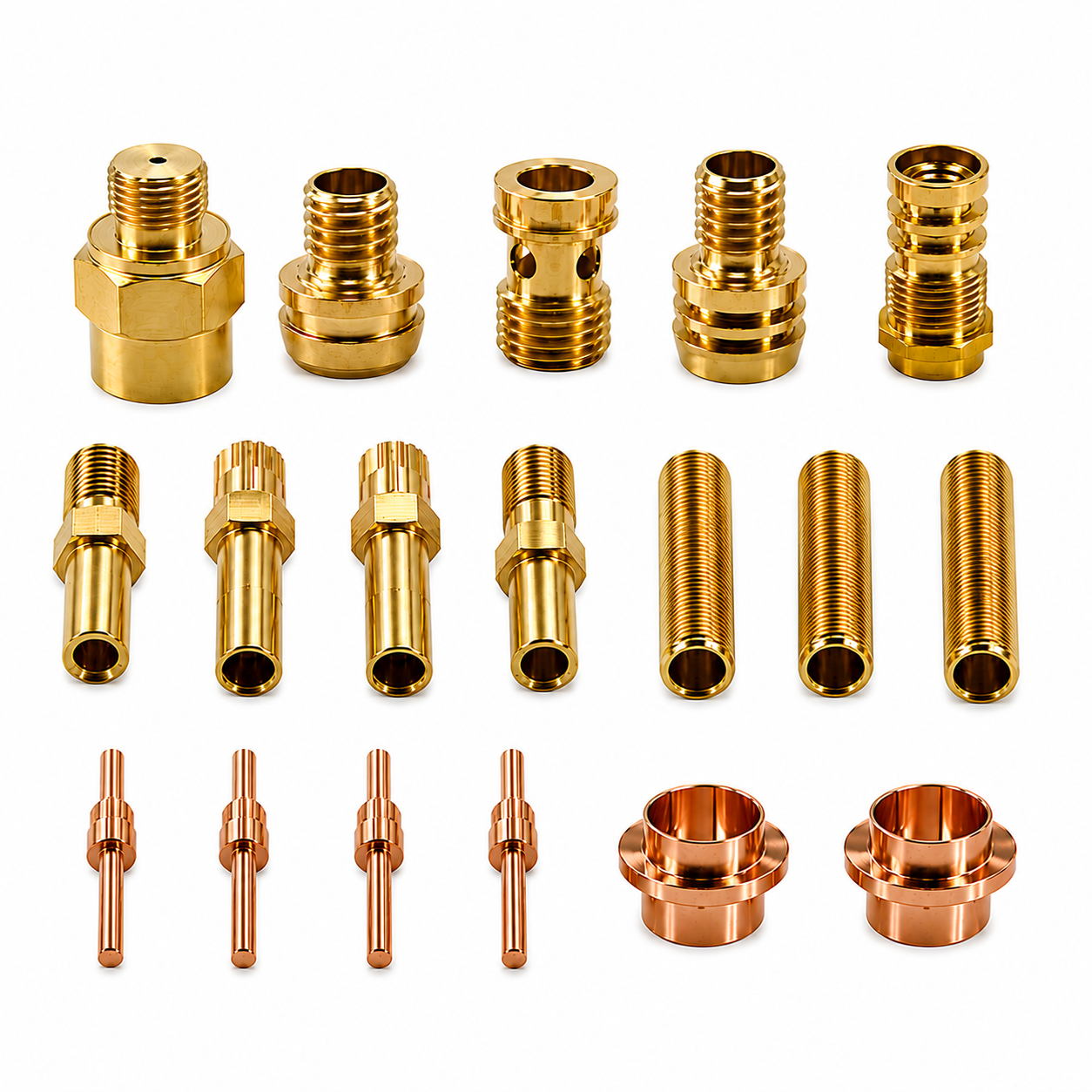
Modern electronic products are becoming smaller, more intelligent, and increasingly integrated. From communication equipment and industrial control systems to sensors, connectors, automation equipment, and electronic devices, manufacturers require precision metal components that can maintain accurate dimensions, reliable assembly, and stable performance.
Behind every sophisticated electronic system are numerous small mechanical components. These parts may not be visible to the end user, but they are essential to the overall structure and functionality of the finished product.
Precision connector housings, terminal components, sensor sleeves, threaded inserts, contact components, mounting brackets, shafts, bushings, spacers, and custom electronic hardware all require accurate manufacturing. In many applications, even a small dimensional deviation can affect assembly, alignment, electrical connection, or the durability of the final product.
This makes precision CNC machining an important manufacturing process for the electronics and telecommunications industries.
As a professional precision CNC machining manufacturer, we provide customized precision electronic components, CNC electronic parts, communication components, sensor components, and electromechanical hardware for OEM and ODM customers.
Our production capabilities include precision CNC turning, Swiss-type CNC machining, CNC milling, multi-axis machining, drilling, tapping, threading, grooving, deburring, and various surface treatment processes.
We work with a wide range of engineering materials, including stainless steel, aluminum alloy, brass, copper alloys, carbon steel, titanium, and engineering plastics according to customer requirements.
For suitable components, our precision machining capability can reach tolerances of up to ±0.005 mm.
Electronic precision components are small mechanical or electromechanical parts manufactured to tight dimensional requirements for use in electronic, electrical, communication, sensing, automation, and control systems.
These components can serve different functions, including:
Typical precision electronic components include:
Because electronic equipment is becoming smaller and more compact, manufacturers increasingly require components with small dimensions, complex geometries, and consistent tolerances.
Connectors are widely used in electronic and communication equipment.
They provide mechanical and electrical interfaces between different circuits, modules, cables, and devices.
Precision-machined connector components can include:
The dimensions of these components need to remain consistent so that the final connector can be assembled efficiently.
A connector housing protects internal contact components while maintaining the correct relationship between mating components.
Depending on the design, a CNC machined connector housing may include:
Aluminum, brass, stainless steel, and other materials can be selected depending on the electrical, mechanical, and environmental requirements.
Contact pins and terminal components are often small precision parts used inside connectors and electronic systems.
They may require extremely consistent:
Swiss-type CNC machining is particularly suitable for producing small-diameter pins and cylindrical electronic components.
For high-volume applications, automatic CNC production can help maintain repeatability between batches.
Sensors are used in almost every modern industrial system.
They can measure:
Precision metal components are often used to support, protect, or position sensor elements.
Typical CNC sensor components include:
A sensor housing protects sensitive internal electronic components from the external environment.
Depending on the application, the housing may need to withstand:
CNC machining allows manufacturers to create accurate internal cavities, threaded interfaces, sealing grooves, and mounting features.
The housing dimensions can be customized according to the customer’s sensor design.
Sensor positioning can influence measurement accuracy.
For example, a sensor used for industrial automation may need to remain in a fixed position relative to a moving machine.
Precision mounting components can include:
These components can be customized according to the customer’s installation requirements.
Telecommunications equipment often contains many small precision metal components.
These may include:
Communication equipment often requires compact designs, making precision CNC machining suitable for manufacturing small and complex metal parts.
Industrial electronic equipment needs to operate reliably in demanding environments.
Precision CNC components can be found in:
These applications may require excellent dimensional stability, corrosion resistance, and mechanical durability.
Bushings are used to provide controlled spacing, support shafts, or reduce friction between moving components.
They are common in:
A CNC machined bushing can be manufactured according to specific:
requirements.
Spacers and sleeves are widely used in electronic assemblies.
They can control the distance between components and help maintain accurate positioning.
Applications include:
Although these components may have relatively simple geometries, dimensional consistency remains important for assembly.
Many electronic and electromechanical systems require threaded components for secure assembly.
Typical products include:
We support metric and imperial thread requirements, including customized thread specifications according to customer drawings.
Different electronic applications require different materials.
The appropriate material depends on:
Stainless steel is an excellent choice when corrosion resistance and mechanical durability are important.
Common grades include:
SUS303
Known for good machinability and suitable for many precision turned components.
SUS304
Provides good corrosion resistance and mechanical performance.
SUS316
Offers enhanced corrosion resistance and can be considered for more demanding environments.
Stainless steel can be used for:
Aluminum alloys are widely used for lightweight electronic components.
Common grades include:
Advantages include:
Applications include:
Brass is widely used for precision electronic components because of its excellent machinability and electrical conductivity.
Applications include:
Brass can also provide an attractive metallic appearance after polishing or other surface treatments.
Copper alloys are suitable for applications where electrical conductivity is an important consideration.
Potential applications include:
The exact copper alloy can be selected according to the customer’s electrical and mechanical requirements.
Carbon steel can be used for components requiring mechanical strength and cost efficiency.
Typical applications include:
Surface treatment can be applied to improve corrosion resistance.
Titanium can be considered for specialized applications where lightweight construction, strength, and corrosion resistance are required.
Although titanium can be more challenging to machine than aluminum or brass, CNC machining can produce customized titanium components according to specific requirements.
Surface treatment can improve product appearance, corrosion resistance, hardness, and wear resistance.
Different materials require different finishing processes.
Anodizing is widely used for aluminum components.
Benefits include:
It is commonly applied to aluminum housings, brackets, mounting plates, and precision electronic components.
Black anodizing provides a professional industrial appearance and is frequently used for electronic and communication equipment.
Applications include:
Hard anodizing can provide improved surface hardness and wear resistance for aluminum components exposed to repeated mechanical contact.
Sandblasting produces a uniform matte surface.
It can be used before anodizing to create a consistent appearance.
Polishing can improve surface smoothness and appearance.
It may be suitable for:
Nickel plating can provide improved corrosion resistance, surface hardness, and wear resistance for suitable components.
It may be used for selected electronic, communication, and mechanical components.
Zinc plating is commonly applied to carbon steel components to provide additional corrosion protection.
Passivation can be used for stainless steel components to improve corrosion resistance and surface cleanliness.
A reliable electronic component manufacturing process begins before the CNC machine starts cutting material.
We review customer drawings for:
The required material is prepared according to the production plan.
The component is produced using the appropriate CNC turning, milling, Swiss-type, or multi-axis machining process.
Machining burrs and sharp edges are removed.
The specified finishing process is completed.
Critical dimensions are measured using precision inspection equipment.
The finished products are checked before packaging and shipment.
Our production capabilities are supported by advanced CNC equipment.
Japanese STAR Swiss-type CNC machines are particularly suitable for small-diameter precision components.
Typical applications include:
Swiss-type CNC machining provides strong workpiece support and is suitable for manufacturing long, thin, and small-diameter components.
Citizen CNC equipment supports high-precision automatic turning.
It is suitable for:
The equipment supports repeatable production for large quantities of precision parts.
Tsugami CNC machines are suitable for precision turning and complex small-component manufacturing.
They can support projects requiring:
Multi-axis CNC machining is suitable for electronic components with more complex geometries.
Potential applications include:
Multi-axis machining can reduce the number of setups required for certain components and help maintain dimensional relationships between different features.
Precision manufacturing requires professional inspection.
Our inspection capabilities include:
These inspection tools allow us to monitor critical dimensions throughout the manufacturing process.
Our quality control process covers multiple stages.
Materials are checked according to customer specifications.
Initial samples are inspected before mass production.
Critical dimensions are monitored during machining.
Finished products are inspected before packaging.
Depending on the project, inspection can cover:
Electronic and communication components frequently require tighter tolerances than conventional hardware.
For suitable CNC machined components, our machining capability can reach ±0.005 mm.
However, actual tolerance capability depends on:
Therefore, we evaluate the customer’s drawing before confirming the final manufacturing capability.
Every electronic equipment manufacturer may have unique component designs.
We therefore support customized OEM and ODM production.
Customers can provide:
Our engineering team can review the design and determine an appropriate machining process.
We can manufacture individual components or multiple related components for the same assembly.
Our CNC precision electronic components can be used across many industries.
We specialize in precision CNC machining and can achieve tolerances up to ±0.005 mm for suitable components.
STAR, Citizen, and Tsugami CNC equipment provides reliable manufacturing capabilities for small and complex precision components.
We process stainless steel, aluminum, brass, copper alloys, carbon steel, titanium, and engineering plastics according to project requirements.
We support anodizing, hard anodizing, sandblasting, polishing, nickel plating, zinc plating, passivation, and other finishing processes.
CMM, optical inspection, CCD vision inspection, precision microscopes, micrometers, and other inspection equipment support our quality control.
We manufacture customized components based on drawings, CAD files, samples, and technical requirements.
We support prototype development, small-batch production, and high-volume manufacturing.
Our ISO 9001 quality management system supports standardized production, process control, inspection, documentation, and continuous improvement.
IATF 16949 is an internationally recognized automotive quality management standard that focuses on controlled processes, risk management, quality consistency, and continuous improvement.
These quality management systems support our commitment to reliable and consistent precision manufacturing.
A successful electronic component project requires more than simply machining the final part.
During the prototype stage, manufacturers need to confirm:
Once the design is approved, the manufacturing process must be stable enough for volume production.
Our CNC production capabilities allow us to support different stages of the product lifecycle.
We manufacture initial samples according to customer drawings.
Small production runs can support product testing and market development.
Stable CNC machining processes support larger production volumes.
Production records and controlled processes help support repeat manufacturing requirements.
Precision electronic components are essential to modern communication systems, industrial automation equipment, sensors, connectors, robotics, automotive electronics, and measurement instruments.
Although many of these parts are small, they require careful control of dimensions, material properties, surface finish, and assembly interfaces.
Components such as connector housings, contact pins, sensor sleeves, precision bushings, spacers, threaded inserts, shafts, brackets, mounting components, and custom electronic hardware all contribute to the performance and reliability of the final product.
With advanced Japanese STAR, Citizen, and Tsugami CNC equipment, multi-axis machining capabilities, professional inspection equipment, a wide range of material options, and comprehensive surface treatment services, we provide customized precision CNC electronic components for customers worldwide.
Our machining capability can reach ±0.005 mm for suitable components, while our quality management systems support stable production and consistent product quality.
Whether you are developing a new sensor, connector, communication device, industrial controller, robotic system, or electronic assembly, we can manufacture precision metal components according to your technical requirements.
From a single prototype to high-volume production, our goal is to provide reliable, accurate, and consistent CNC machined electronic components that help our customers develop better products and more efficient manufacturing solutions.
If you are interested in this exceptional product, please feel free to contact us through the message box on the left side or the contact information provided below. We are eager to collaborate with you for a brighter future!