
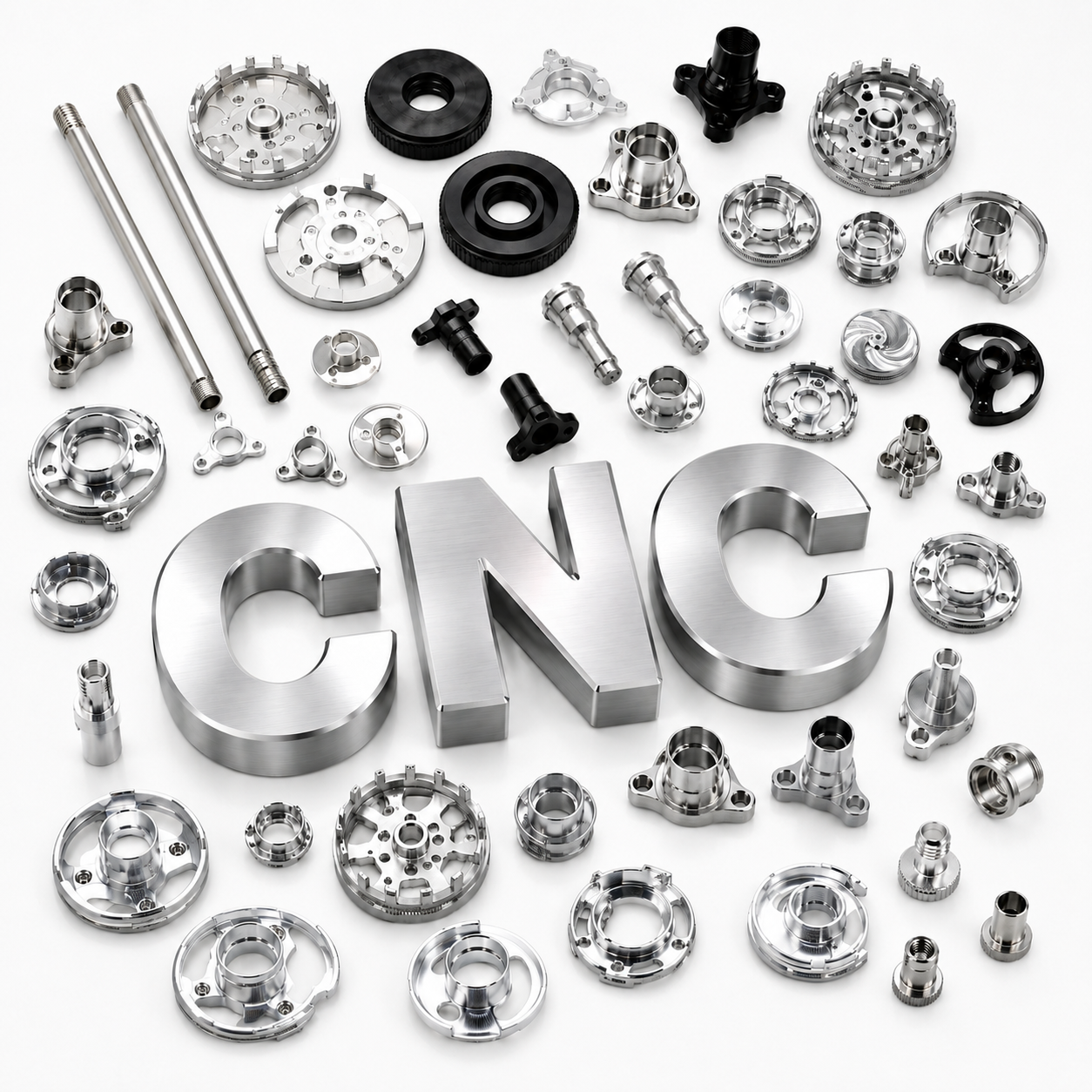
The performance of a drone motor depends on much more than the electrical winding and control system. Inside every high-performance brushless drone motor is a combination of precisely manufactured mechanical components that work together to provide stable rotation, efficient power transmission, accurate magnetic positioning, and long-term durability.
Components such as rotor bells, magnetic rings, motor shafts, motor covers, bearing seats, end caps, mounting plates, and other custom CNC machined parts form the mechanical foundation of modern drone motors.
For UAV manufacturers, drone motor brands, and precision electronics companies, the dimensional accuracy of these components is critical. A small deviation in concentricity, shaft diameter, magnetic ring positioning, or rotor balance can affect motor vibration, efficiency, noise, temperature, and overall flight performance.
As a professional precision CNC machining manufacturer, we provide customized metal components for drone motors and UAV propulsion systems. Our manufacturing capabilities cover small-diameter turning, Swiss-type CNC machining, milling, drilling, threading, grooving, and secondary surface treatment processes.
We manufacture components according to customer drawings, 3D models, samples, and technical specifications, supporting both prototype development and mass production.
Our precision machining capability can achieve tolerances of up to ±0.005 mm, depending on component geometry, material, and production requirements.
A brushless drone motor typically contains several precision mechanical components. Each component has a specific role in the motor assembly.
Our manufacturing range includes:
These components can be manufactured individually or supplied as a complete set according to customer requirements.
The rotor bell is one of the most recognizable components of a brushless drone motor.
The rotor bell forms the external rotating structure of the motor and typically holds the permanent magnets around its inner circumference. During operation, the rotor rotates at high speed around the stator assembly.
Because the rotor bell rotates continuously, dimensional accuracy and balance are extremely important.
A precision rotor bell may require strict control over:
A properly machined rotor bell helps maintain stable rotation and reduces unnecessary vibration.
Common materials include:
Aluminum is particularly attractive for drone motor applications because it combines low weight with good mechanical strength and excellent machinability.
The magnetic ring is an important component in brushless motor assemblies.
Permanent magnets are typically arranged around the rotor structure to interact with the stator’s electromagnetic field.
The positioning and geometry of the magnetic ring directly influence the motor’s electromagnetic performance.
Our CNC machining capabilities can produce precision metal structures designed to accommodate magnetic rings and permanent magnets.
Depending on the motor design, these components may include:
Magnetic components must be positioned consistently around the rotor.
Poor mechanical positioning can contribute to:
Precision machining helps provide a stable mechanical reference for magnet installation.
The motor shaft transfers mechanical rotation from the motor assembly to the propeller or other rotating components.
It is one of the most important load-bearing components in a drone motor.
Depending on the motor design, the shaft may include:
Motor shafts often require accurate control of:
The shaft must fit correctly with bearings and rotating components while maintaining reliable alignment at high rotational speeds.
The motor cover or end cover provides structural support and protects internal motor components.
Depending on the motor design, the cover may include:
A precision motor cover helps maintain correct positioning between the rotor, shaft, bearings, and stator assembly.
For lightweight UAV motors, aluminum alloy is often an excellent material choice because it provides good strength while keeping overall motor weight low.
Bearings allow the rotor and shaft to rotate smoothly.
The bearing seat therefore requires careful machining.
Typical requirements include:
A poorly machined bearing seat can result in excessive clearance or interference, which may cause vibration, noise, friction, or premature bearing wear.
Our CNC turning equipment is suitable for manufacturing small bearing seats, sleeves, and precision cylindrical components.
Small spacers and positioning rings are often used inside drone motor assemblies.
Although these components may look simple, their dimensions can affect the overall motor assembly.
Applications include:
We manufacture customized spacers and rings according to exact drawing dimensions.
Material selection is critical because UAV motors require a combination of low weight, strength, dimensional stability, and corrosion resistance.
Aluminum is one of the most commonly considered materials for drone motor components.
Common grades include:
Advantages include:
Aluminum is suitable for:
Stainless steel is suitable for components requiring higher strength and corrosion resistance.
Common grades include:
Applications include:
Carbon steel can be used for applications where mechanical strength and cost efficiency are important.
Depending on the final application, surface treatment can be applied to improve corrosion resistance.
Brass and copper alloys can be considered for selected electrical, conductive, or precision mechanical components.
Brass provides excellent machinability and stable dimensional performance.
Surface treatment can improve corrosion resistance, wear resistance, surface hardness, and product appearance.
Anodizing is widely used for aluminum drone motor components.
Advantages include:
Black anodizing is particularly popular for drone motor housings and rotor components.
It provides a professional appearance and can reduce unwanted surface reflection.
Hard anodizing provides a harder and more wear-resistant aluminum surface.
It can be considered for components exposed to repeated mechanical contact.
Sandblasting creates a uniform matte surface and can be combined with anodizing.
It is commonly used for:
Polishing can produce a smoother surface finish for selected stainless steel, aluminum, or brass components.
For suitable steel components, surface treatments such as zinc plating or nickel plating can provide additional corrosion protection.
Drone motor components often have relatively small dimensions but require high manufacturing accuracy.
Our CNC machining capabilities include:
| Capability | Specification |
|---|---|
| Precision Tolerance | Up to ±0.005 mm |
| Diameter Range | Approximately 2–33 mm for suitable turned components |
| Surface Roughness | Ra0.4–Ra1.6 |
| Threading | Metric / UNC / UNF / Custom |
| Materials | Aluminum / Stainless Steel / Brass / Steel / Copper Alloys |
| Production | Prototype to Mass Production |
Actual machining capability depends on the specific component design and customer drawing.
Our factory uses advanced CNC equipment for precision metal components.
Japanese STAR Swiss-type CNC machines are highly suitable for producing small-diameter precision components.
Applications include:
Swiss-type machining provides strong workpiece support and excellent dimensional stability for small precision parts.
Citizen CNC equipment supports efficient production of small and complex components with high repeatability.
Tsugami CNC machines are used for high-precision turning and complex small-component manufacturing.
Multi-axis machining allows us to produce more complex components with multiple machining features.
Applications include:
High-speed drone motors require precise and reliable components.
Our inspection equipment includes:
These inspection systems allow us to monitor critical dimensions throughout production.
Our quality control process includes several stages.
Material specifications are checked before production.
Initial samples are inspected according to customer drawings.
Critical dimensions are monitored during machining.
Finished components are inspected before packaging.
Depending on the project, inspection may cover:
Our precision CNC drone motor components can be used in various UAV applications.
High-speed FPV drones require lightweight and reliable motor components.
Racing motors operate at high rotational speeds and require precise rotor structures and shafts.
Professional camera drones require reliable motors for stable and efficient flight.
Industrial drones may require stronger and more durable motor components for extended operation.
Agricultural UAVs operate in demanding outdoor environments, making corrosion resistance and component reliability particularly important.
Delivery UAVs require lightweight propulsion systems capable of supporting longer operating periods.
We also support custom drone motor component development based on customer motor designs.
Different drone motor manufacturers may use different structural designs.
Therefore, standard components may not always meet specific requirements.
We support customized manufacturing based on:
Customers can send us their existing drawings or samples for quotation and manufacturing evaluation.
We can manufacture individual components or multiple components within the same motor assembly.
We specialize in high-precision CNC machining and can achieve tolerances up to ±0.005 mm for suitable components.
Our STAR, Citizen, and Tsugami equipment is well suited for small-diameter and high-precision UAV motor components.
We can manufacture multiple components within a drone motor assembly, including rotor bells, magnetic ring holders, shafts, covers, bushings, sleeves, spacers, and custom hardware.
We process aluminum, stainless steel, brass, copper alloys, carbon steel, and other engineering materials.
We provide anodizing, hard anodizing, sandblasting, polishing, plating, and other finishing processes according to project requirements.
CMM, optical inspection, CCD vision systems, microscopes, and precision measuring tools help maintain consistent quality.
We manufacture according to customer drawings, samples, and customized technical requirements.
We support new product development, prototype production, small-batch orders, and high-volume manufacturing.
Our quality management system supports international manufacturing requirements.
We hold:
ISO 9001
ISO 9001 provides a structured framework for quality management, production control, inspection, documentation, and continuous improvement.
IATF 16949
IATF 16949 is an internationally recognized automotive quality management standard and demonstrates our focus on controlled manufacturing processes and consistent quality.
Drone motor performance depends on the interaction of electrical, magnetic, and mechanical systems. Precision-machined components such as rotor bells, magnetic ring holders, motor shafts, covers, bearing seats, spacers, and positioning rings form an essential part of this system.
Every component must be manufactured with appropriate dimensional accuracy, material properties, surface treatment, and quality control.
With Japanese STAR, Citizen, and Tsugami CNC equipment, multi-axis machining capabilities, professional inspection systems, and precision tolerances up to ±0.005 mm, we provide customized CNC components for drone motor manufacturers and UAV equipment companies.
From a single precision motor shaft to a complete set of rotor bells, magnetic ring structures, covers, sleeves, and mounting components, we support customers from prototype development through mass production.
Our goal is to provide reliable, repeatable, and cost-effective precision metal components that help drone manufacturers build lighter, stronger, and more efficient UAV propulsion systems.
If you are interested in this exceptional product, please feel free to contact us through the message box on the left side or the contact information provided below. We are eager to collaborate with you for a brighter future!